How an international NGO manages beneficiaries, aid distribution and finance in one integrated ERP
The client is a UN-affiliated non-profit serving people with disabilities and displaced people, providing education and material support. Managing services across several regions without an integrated system made coordination and reporting difficult.

A UN-affiliated international NGO
Non-profit organization (NGO), UN-affiliated
Analysis, system design, development and implementation
The challenge
The organization delivers services across several regions. Without an integrated system, it was hard to distribute services fairly, track stock and purchases, follow expenses and coordinate between departments. Leadership also needed accurate reports to make decisions and account for every service delivered. The goal was to one system for all departments and operations; Accurate, transparent distribution of services to beneficiaries. Key constraints included services spread across several regions and beneficiary groups, Very different needs: education, material aid, inventory and finance in one platform.
What we built
We built a large, integrated ERP made of connected modules that work together, plus a public website with its own CMS.
Key features & deliverables
Beneficiary registration
Register people with disabilities and displaced people, allocate services based on needs and report on beneficiaries and programs.
Inventory & procurement
Track distributed items, manage purchasing and supply, and monitor stock to avoid shortages or surplus.
Financial management
Track expenses, manage budgets and spending, and produce financial reports and forecasts.
Education & services
Manage education programs, enrol beneficiaries in courses and follow services delivered to each family or individual.
Architecture & implementation
Architecture
Modular ERP where beneficiaries, services, education, inventory and finance work together. The public website runs on a custom CMS.
Access
Role-based permissions per department: management, services, finance, education and inventory.
What changed
| Before | After |
|---|---|
| Services hard to manage across regions | Central management of services across all regions |
| No integrated way to distribute services | Needs-based, automated service allocation |
| Weak control of stock and purchases | Live inventory and procurement tracking |
| Limited financial follow-up | Integrated budgets, expenses and financial reports |
| Departments working in silos | One platform with role-based access for each department |
Client outcomes
- Beneficiaries, services, inventory and finance are managed in one system.
- Services are distributed more accurately and transparently.
- Leadership gets instant reports to support decisions.
- Integrated infrastructure for the whole organization
- Accurate and transparent service distribution
- Decision support through instant reports
- Easier management of people, finance and inventory
- Ready to scale services internationally
Delivering services to many people across many places?
If your organization struggles to track beneficiaries, resources or spending, let's talk. We'll help you see where an integrated system can bring accuracy and transparency.
Related case studies
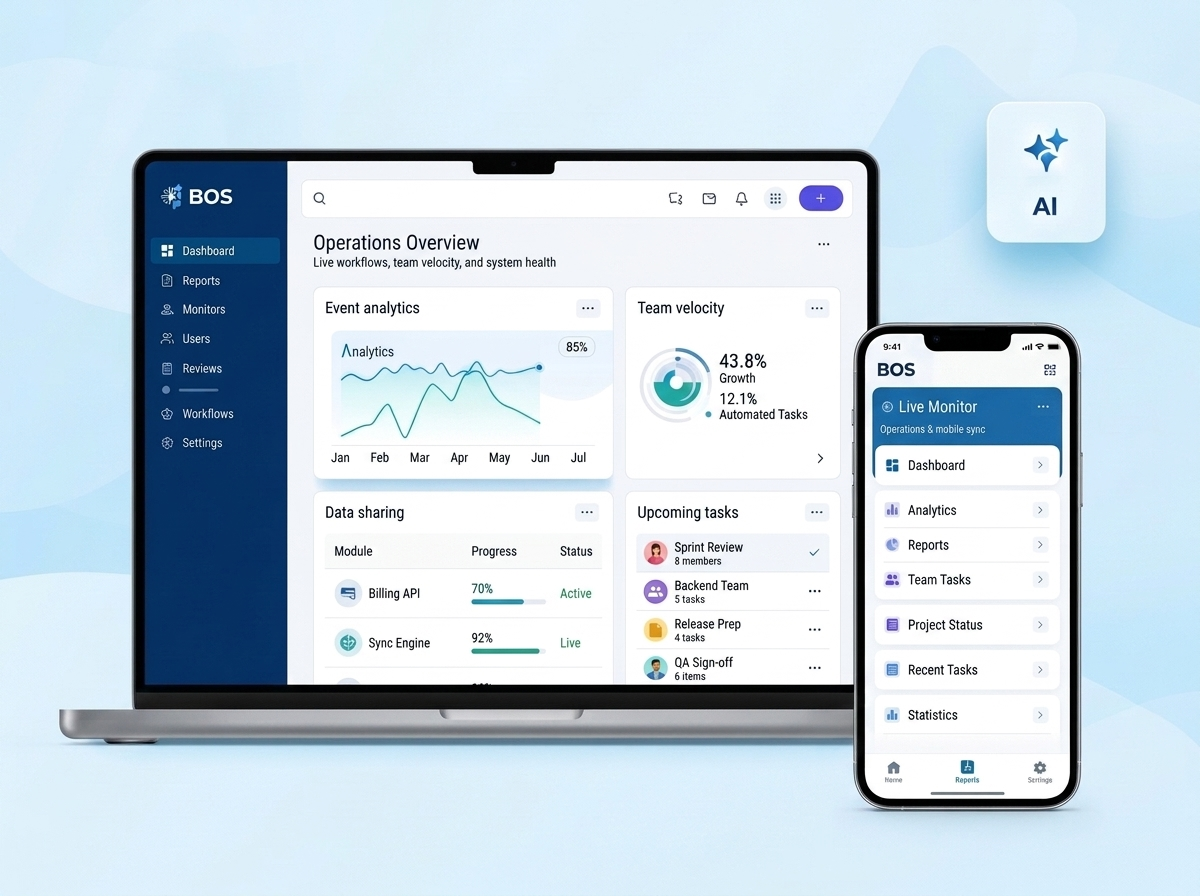
BOS – AI-Powered Business Operating System (SaaS)
From idea to SaaS product: one AI-powered system to run the whole enterprise — All departments in one platform

Packaged Cement Manufacturer
One connected ERP for cement production and distribution — Custom ERP with inventory and tracking

Multi-Country Virtual School
A complete virtual school, run from one integrated platform — Complex multi-role platform